
Restore Pharma | Peptide Education & Regulatory Updates
November 2026 | Tampa Bay, Florida
The conversation surrounding peptide therapy and compounding pharmacy is far from over. Following a closely watched FDA advisory committee meeting in July 2026, another group of experimental peptides is preparing to undergo federal scientific and regulatory review.
This next meeting could become another important moment for patients, healthcare providers, and compounding pharmacies interested in the future of personalized medicine.
The FDA's Pharmacy Compounding Advisory Committee, commonly called the PCAC, is expected to meet before the end of February 2027 to evaluate five additional peptide and peptide-related bulk drug substances.
The substances scheduled for discussion are GHK-Cu, LL-37, Dihexa acetate, Melanotan II, and pegylated mechano growth factor, commonly called PEG-MGF.
These compounds have attracted attention for very different reasons, ranging from skin and wound research to antimicrobial activity, neurological signaling, pigmentation, and muscle regeneration.
But what exactly will the FDA be evaluating? What happened during the previous peptide votes? And could another favorable committee decision eventually change how certain peptides are accessed through licensed compounding pharmacies?
At Restore Pharma, we're following these developments closely because we believe patients and prescribers deserve clear, accurate information about the evolving landscape of peptide research and pharmaceutical compounding.
What Is the Pharmacy Compounding Advisory Committee?
The Pharmacy Compounding Advisory Committee is a federal advisory committee that provides independent scientific and clinical recommendations to the FDA on matters involving pharmaceutical compounding.
One of its responsibilities is reviewing certain bulk drug substances nominated for inclusion on the Section 503A Bulks List.
Under Section 503A of the Federal Food, Drug, and Cosmetic Act, qualifying traditional compounding pharmacies may prepare patient-specific medications when applicable legal requirements are met.
However, the active ingredients used in compounded medications must meet specific eligibility requirements.
For substances that do not qualify through other statutory pathways, inclusion on the 503A Bulks List can be an important part of determining whether they may be used in compounding.
The PCAC considers scientific evidence and provides recommendations to the FDA, but its votes are advisory rather than binding.
A favorable vote does not automatically approve a peptide, authorize its use in compounded medications, or establish that it is safe and effective.
The FDA retains responsibility for final regulatory decisions.
What Happened During the July 2026 Peptide Votes?
On July 23 and 24, 2026, the PCAC evaluated seven peptide substances for possible inclusion on the 503A Bulks List.
The meeting attracted considerable attention because the committee ultimately recommended six of the seven substances, despite FDA staff evaluations recommending against their inclusion.
The substances reviewed included BPC-157, KPV, TB-500, MOTS-c, Emideltide (DSIP), Epitalon, and Semax.
Each substance was evaluated in relation to specific proposed medical uses, and the committee considered the free-base and acetate forms separately.
The reported voting results were as follows:
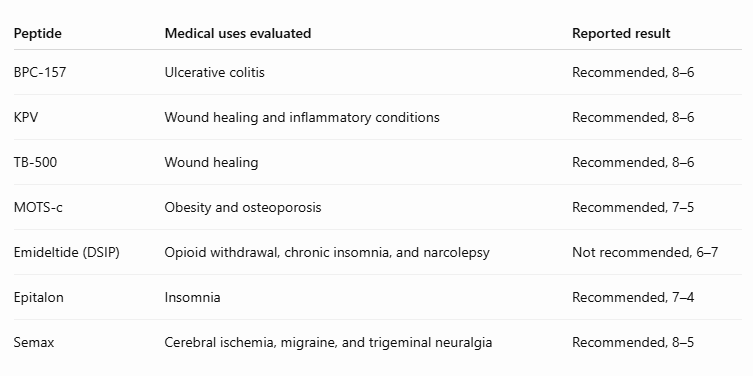
These are the reported yes-to-no tallies, with abstentions omitted for readability. The FDA reviewed specific chemical forms separately, and the formal meeting record remains the authoritative source for final vote details.
The results represented a significant development because the advisory committee reached different conclusions from FDA staff on six of the seven substances.
However, the committee's recommendations did not constitute FDA approval or automatically place those peptides on the final 503A Bulks List.
The meeting also highlighted the challenges involved in evaluating emerging peptide therapies. For several substances, researchers have identified interesting biological mechanisms, but high-quality human clinical evidence remains limited.
That distinction is likely to remain central to the next review.
Which Five Peptides Are Being Evaluated in Early 2027?
According to the FDA's published meeting announcement, five additional substances are expected to be discussed before the end of February 2027.
The agency has identified the substances but has not yet published the specific medical indications it intends to evaluate for each one.
The following descriptions therefore explain the compounds' principal areas of scientific investigation rather than confirmed indications for the upcoming PCAC meeting.
1. GHK-Cu: Copper Peptides, Skin Health, and Tissue Repair
GHK-Cu is a copper-binding peptide complex that has attracted considerable interest in dermatology, wound healing, and skin biology.
GHK stands for glycyl-L-histidyl-L-lysine, a naturally occurring tripeptide that can bind copper ions.
Copper plays an important role in several biological processes, including connective tissue formation, antioxidant enzyme activity, and normal tissue maintenance.
Researchers have investigated whether GHK-Cu influences fibroblast activity, extracellular matrix remodeling, collagen-related pathways, and wound-healing responses.
These findings have contributed to interest in GHK-Cu for skin rejuvenation, tissue repair, and other dermatological applications.
Some laboratory studies have also explored its potential influence on gene expression and cellular responses associated with aging.
However, the evidence supporting topical cosmetic applications should not automatically be extended to injectable administration.
Injectable GHK-Cu presents different questions involving systemic exposure, formulation safety, copper-related biological effects, and long-term tolerability.
This distinction is particularly important for the upcoming review because injectable GHK-Cu has been a specific focus of FDA compounding concerns.
For patients interested in skincare, GHK-Cu remains an interesting area of cosmetic and pharmaceutical research, but its effects depend on the formulation, route of administration, and intended use.
2. LL-37: Antimicrobial Activity and Immune Defense
LL-37 is a naturally occurring antimicrobial peptide associated with the body's innate immune system.
It is derived from a larger protein called human cathelicidin antimicrobial protein, which helps the body respond to certain microorganisms and environmental challenges.
LL-37 has attracted attention because laboratory studies have demonstrated activity against various bacteria and other microorganisms under experimental conditions.
Researchers have also investigated its relationship with inflammatory signaling, immune cell recruitment, and wound-healing processes.
These properties make LL-37 particularly interesting in research involving antimicrobial defense and tissue repair.
However, the immune system requires careful regulation.
LL-37 can participate in both protective and potentially harmful inflammatory processes depending on the biological environment.
Researchers have investigated its involvement in inflammatory skin conditions and other disorders where immune signaling becomes dysregulated.
This means that increasing LL-37 activity cannot automatically be assumed to improve immune function.
There is insufficient high-quality human clinical evidence establishing administered LL-37 as a safe and effective treatment for infections, chronic wounds, or inflammatory diseases.
Its inclusion in the upcoming PCAC discussion may provide an opportunity for a more detailed public examination of the available evidence.
3. Dihexa Acetate: Neurological Signaling and Cognitive Research
Dihexa is an experimental compound that has generated interest in neuroscience and cognitive research.
Unlike some of the other substances under review, Dihexa is a small peptide-derived molecule investigated for its potential effects on neurological signaling.
Early research has explored its relationship with hepatocyte growth factor, or HGF, and the c-Met signaling pathway.
These pathways participate in cellular growth, survival, and communication.
In experimental neurological models, researchers have investigated whether Dihexa-related signaling influences synapse formation and processes associated with learning and memory.
Synapses are specialized connections that allow nerve cells to communicate with one another.
Because synaptic function is essential for normal cognition, substances that influence these pathways have attracted interest in research involving neurodegenerative disease and cognitive impairment.
However, most of the enthusiasm surrounding Dihexa comes from laboratory and animal research.
There is insufficient human clinical evidence demonstrating that Dihexa improves memory, treats Alzheimer's disease, or prevents cognitive decline.
The HGF/c-Met pathway is also involved in cell growth and has relevance to cancer biology, making long-term safety an especially important research question.
Dihexa acetate's upcoming review may help clarify how federal regulators weigh these potential biological activities against the limited clinical evidence and unresolved safety concerns.
4. Melanotan II: Pigmentation and Melanocortin Research
Melanotan II is a synthetic peptide that interacts with melanocortin receptors, a family of receptors involved in several physiological processes.
Its best-known area of research involves pigmentation.
Melanocortin signaling helps regulate melanin production, the process responsible for much of the natural pigmentation of skin and hair.
Because of this relationship, Melanotan II has been investigated for its ability to influence skin pigmentation.
Researchers have also studied its effects on other melanocortin-mediated processes, including sexual behavior and appetite-related signaling.
However, Melanotan II is not an FDA-approved tanning medication, and its ability to increase pigmentation should not be confused with demonstrated protection against ultraviolet radiation.
A darker appearance does not eliminate the need for sunscreen or other established skin cancer prevention measures.
Melanotan II has also been associated with safety concerns, including nausea, flushing, changes in pigmented skin lesions, and other adverse effects.
These concerns are especially important because unregulated tanning products have been marketed directly to consumers.
The upcoming PCAC review will provide an opportunity to evaluate the compound within the broader context of pharmaceutical quality, clinical evidence, and patient safety.
5. PEG-MGF: Muscle Growth and Regeneration Research
Pegylated mechano growth factor, commonly called PEG-MGF, is another peptide-related substance scheduled for review.
Mechano growth factor is a name associated with a particular splice variant of insulin-like growth factor-1, or IGF-1, that has been studied in relation to mechanical stress and muscle biology.
Researchers have investigated IGF-1-related signaling in skeletal muscle growth, repair, and adaptation to physical activity.
These processes are particularly interesting because skeletal muscle must continually respond to exercise, injury, and changing metabolic demands.
PEG-MGF refers to a modified preparation associated with an MGF-derived peptide.
The term pegylated means that polyethylene glycol has been chemically attached to a molecule, a strategy sometimes used in pharmaceutical development to alter stability, circulation time, or other pharmacokinetic properties.
However, attaching polyethylene glycol to a peptide does not automatically establish improved clinical performance.
PEG-MGF should also not be assumed to behave identically to naturally occurring IGF-1 splice variants or unmodified MGF-related peptides.
Although the compound has attracted interest in muscle recovery and regeneration research, there is insufficient human clinical evidence demonstrating that PEG-MGF safely increases muscle mass, improves athletic performance, or accelerates recovery from injury.
Its relationship with growth-related signaling also raises questions that require careful evaluation, including the possibility of unintended effects on tissues outside skeletal muscle.
For patients interested in muscle health, this is an area where promising biological mechanisms must be distinguished from demonstrated clinical outcomes.
What Will the FDA Be Looking For?
The PCAC's review is not simply a vote on whether a peptide sounds promising.
The FDA evaluates nominated bulk drug substances using several scientific and regulatory considerations.
These include the physical and chemical characterization of the substance, the availability of safety information, evidence of effectiveness for proposed medical uses, historical use in compounding, and whether approved medications already address the relevant conditions.
Chemical characterization is especially important for peptides because relatively small differences in molecular structure can influence biological activity.
The agency may also examine impurities, manufacturing consistency, potential immune reactions, and the quality of available clinical evidence.
For certain substances, formulation characteristics and the intended route of administration can introduce additional safety considerations.
The committee must weigh these factors when deciding whether to recommend inclusion on the 503A Bulks List.
It's possible for a substance to demonstrate interesting biological activity while still lacking sufficient evidence to support its use in compounded medications.
That was one of the central issues during the July 2026 meeting, and it will likely remain important during the upcoming review.
Why Does the February 2027 Meeting Matter?
For patients and prescribers interested in emerging peptide therapies, the next PCAC meeting represents another step in an evolving regulatory process.
The July meeting demonstrated that advisory committee members may interpret the available evidence differently from FDA staff.
However, the next meeting should not be viewed as a guarantee that the five substances will receive favorable recommendations.
Each compound presents different scientific questions, levels of evidence, and potential safety concerns.
Even if the committee recommends a substance, the FDA must still determine what regulatory action is appropriate.
A favorable recommendation does not automatically make a peptide available through a compounding pharmacy.
Likewise, a negative recommendation does not necessarily mean that all future scientific investigation must stop.
The committee's role is to provide advice within a specific regulatory framework.
For pharmacies, prescribers, and patients, understanding that framework is essential.
What Does This Mean for 503A Compounding Pharmacies?
Traditional 503A compounding pharmacies prepare individualized medications for patients when applicable legal requirements are met.
Compounding can be especially valuable when a patient has a legitimate medical need that cannot be addressed by a suitable commercially available medication.
However, not every substance can legally be used in compounding simply because a prescriber requests it.
Ingredient eligibility, prescription requirements, pharmaceutical quality standards, and applicable federal and state regulations all matter.
The PCAC's recommendations are one part of the process used to evaluate certain nominated bulk drug substances.
For emerging peptides, the distinction between scientific research, regulatory eligibility, and clinical effectiveness is particularly important.
A substance may be under scientific investigation without being FDA-approved.
A substance may receive a favorable advisory committee recommendation without being placed on the final 503A Bulks List.
And a compounded preparation may be legally permissible under certain circumstances without having undergone FDA premarket review for safety and effectiveness.
These distinctions help explain why regulatory developments should be followed carefully rather than interpreted as blanket authorization for peptide compounding.
When Will the Next PCAC Meeting Take Place?
The FDA has announced that the next Pharmacy Compounding Advisory Committee meeting will occur before the end of February 2027.
As of November 10, 2026, the agency has not announced an exact meeting date.
The FDA has indicated that additional information will be published, including meeting materials, public participation instructions, and details about the online webcast.
The agency also intends to establish a public comment docket.
This is important because public participation allows interested individuals and organizations to submit scientific information, clinical perspectives, and other relevant comments for consideration.
Healthcare professionals, researchers, patient advocates, and other stakeholders may have opportunities to participate in the process.
The official FDA meeting page will be the most reliable place to follow scheduling announcements and newly published documents.
Our Perspective at Restore Pharma
The upcoming PCAC meeting is another example of how quickly the conversation surrounding peptide science is evolving.
Just a few years ago, many of these compounds were discussed almost exclusively in research settings.
Today, they are increasingly part of broader conversations involving regenerative medicine, metabolic health, dermatology, neurological research, and personalized pharmaceutical care.
That growing interest makes responsible education more important than ever.
At Restore Pharma, we're encouraged by continued scientific discussion and the opportunity for emerging compounds to receive thorough evaluation.
But we're equally committed to distinguishing research potential from established clinical benefits.
GHK-Cu, LL-37, Dihexa acetate, Melanotan II, and PEG-MGF each present different scientific possibilities and different unanswered questions.
The upcoming review will help bring greater attention to those distinctions.
As a boutique, pharmacist-led compounding pharmacy serving Tampa Bay and patients in other states where we're appropriately licensed, Restore Pharma believes personalized medicine should be grounded in pharmaceutical quality, transparent communication, and collaboration with healthcare providers.
We'll continue following the PCAC process and sharing updates as official information becomes available.
Because innovation in healthcare is important, but understanding the science and the regulatory process behind that innovation is just as important.
Feel your best. Then feel better.
Patrick Alonso, PharmD, CPh
Steve Caddick, PharmD
Restore Pharma | Tampa Bay, Florida
Frequently Asked Questions About the February 2027 PCAC Peptide Review
Which peptides will the FDA review in February 2027?
The FDA has identified five substances for its next Pharmacy Compounding Advisory Committee meeting: GHK-Cu, LL-37, Dihexa acetate, Melanotan II, and PEG-MGF. The meeting is expected before the end of February 2027, but an exact date has not been announced.
What are these peptides being evaluated for?
The committee will consider whether the nominated substances should be included on the 503A Bulks List. Their areas of scientific investigation include tissue repair, antimicrobial activity, neurological signaling, pigmentation, and muscle biology. The FDA has not yet announced the specific medical indications it will formally evaluate for each substance.
How many peptides were reviewed in July 2026?
Seven peptide substances were reviewed. The committee recommended six for inclusion on the 503A Bulks List and did not recommend Emideltide, also known as DSIP.
Does a favorable PCAC vote mean a peptide is FDA approved?
No. PCAC recommendations are advisory and do not constitute FDA approval. They also do not automatically authorize a substance for compounding.
Does this mean GHK-Cu injections will become available?
Not necessarily. The upcoming review includes GHK-Cu, but any future availability of injectable compounded preparations will depend on subsequent regulatory decisions, applicable laws, and pharmacy-specific requirements.
Can patients submit comments to the FDA?
The FDA has indicated that public participation will be available and that it intends to establish a public comment docket. Instructions and deadlines should be confirmed through the official meeting announcement.
Where can patients follow updates?
Patients and healthcare providers can monitor the FDA's Pharmacy Compounding Advisory Committee meeting page and follow Restore Pharma's educational articles for explanations of major developments.
Educational Disclaimer: This article is intended for informational purposes only and does not constitute medical advice. The substances discussed are not FDA-approved for the research applications described. Advisory committee recommendations do not constitute FDA approval or automatically authorize compounding. References to emerging research and future regulatory review do not imply that any specific preparation is available from Restore Pharma. Regulatory details may change as the FDA publishes additional information.
